Learn Japanese
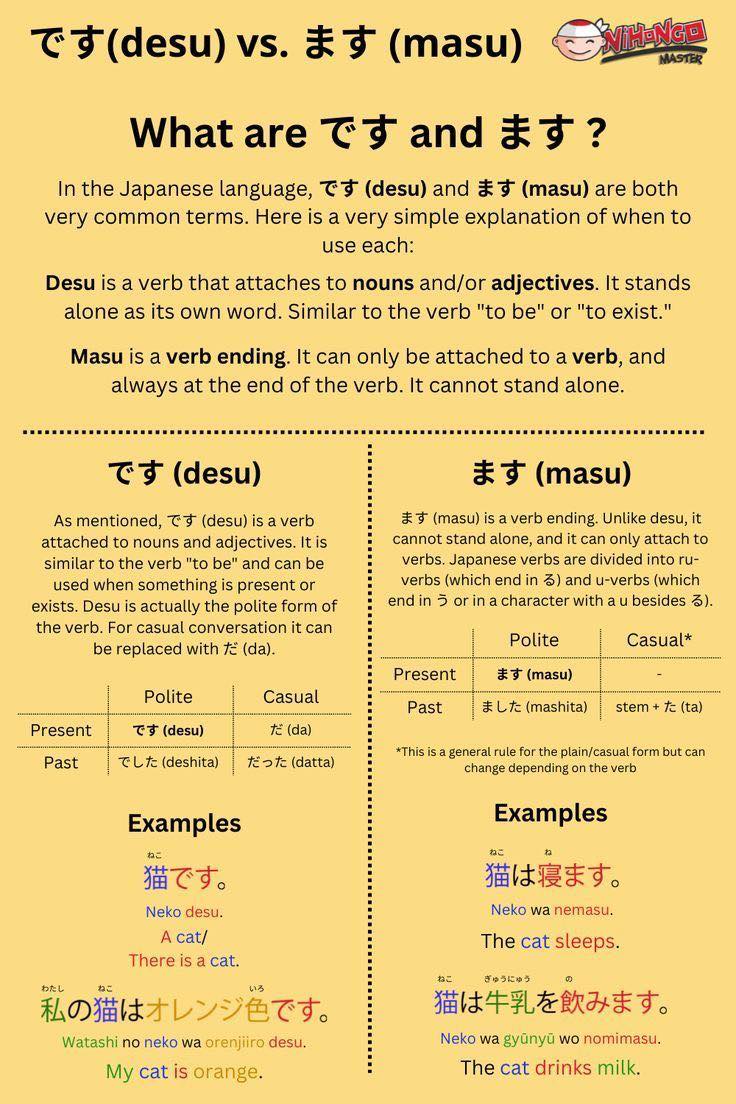
The difference between です and ます in Japanese
| Feature | です (desu) | ます (masu) |
|---|---|---|
| Used with | Nouns & Adjectives | Verbs |
| Meaning | “to be” (is / am / are / exists) | Polite verb ending |
| Can stand alone? | ✅ Yes | ❌ No |
| Polite → Casual | です → だ | ます → dictionary/plain form |
| Past tense | でした (deshita) → だった (datta) | ました (mashita) → verb + た (ta) |
Examples
です (desu)
-
猫です。(Neko desu.) → It’s a cat.
-
これは本です。(Kore wa hon desu.) → This is a book.
ます (masu)
-
食べます。(Tabemasu.) → I eat.
-
勉強します。(Benkyou shimasu.) → I study.
Related Post:
Japanese Grammar: Potential Form
How to make Verb te-form in Japanese