Learn Japanese
How to use Japanese particles で (de) and に (ni) with places
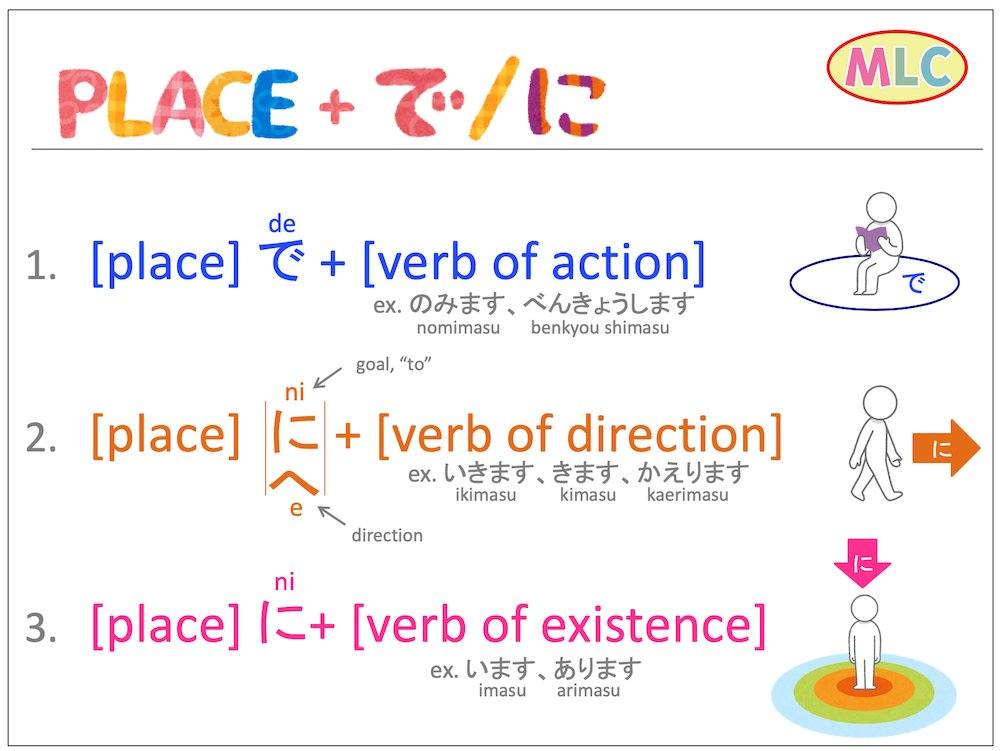
1. Place + で + verb of action
で = the place where an action happens
=> Use で when someone does an action at a location.
Structure:
[Place] + で + action verb
Common action verbs:
のみます (drink)
たべます (eat)
べんきょうします (study)
はたらきます (work)
あそびます (play)
Examples:
カフェで コーヒーを のみます。
(かふぇで こーひーを のみます。)
I drink coffee at a café.
図書館で べんきょうします。
(としょかんで べんきょうします。)
I study at the library.
Tip: If there is an activity or action, think で.
2. Place + に + verb of direction (movement)
に = destination / direction
=> Use に when you move toward a place.
Structure:
[Place] + に + verb of movement
Common movement verbs:
いきます (go)
きます (come)
かえります (return)
Examples:
学校に いきます。
(がっこうに いきます。)
I go to school.
日本に きます。
(にほんに きます。)
I come to Japan.
Tip: If the verb means go / come / return, use に.
3. Place + に + verb of existence
に = location where someone or something exists
=> Use に to say someone or something is located somewhere.
Verbs of existence:
います → for people and animals
あります → for objects and plants
Examples:
先生は 教室に います。
せんせいは きょうしつに います。
The teacher is in the classroom.
机の上に 本が あります。
つくえの うえに ほんが あります。
There is a book on the desk.
Tip: If the meaning is “to be” or “to exist”, use に.
Final quick tip:
で → action happens there
に → go there / exist there
Related Post:
How to Use “~んです” in Japanese
How to Say Yesterday, Today, Tomorrow in Japanese