Learn Japanese
Here are Japanese conjunction you should know
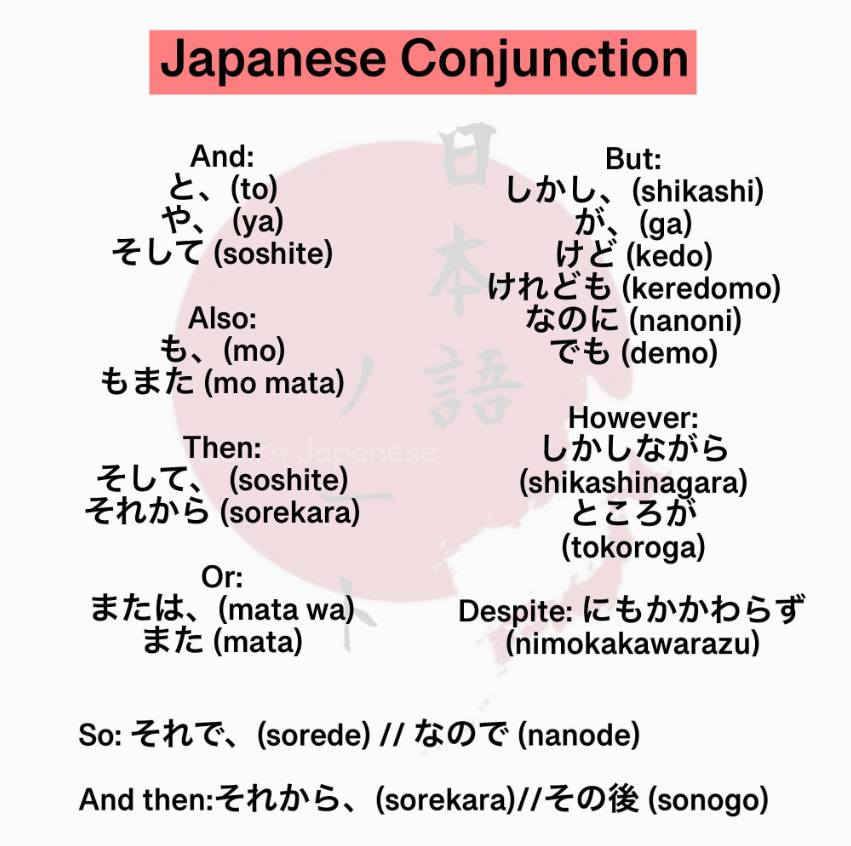
Common Japanese Conjunctions List
| Japanese | Romaji | English |
| そのため | sonotame | so, therefore, for that reason, consequently |
| だから | dakara | so, therefore, consequently |
| それで | sorede | and, and then, therewith |
| そこで | sokode | so, and, then |
| したがって | shitagatte | thus, therefore, in this way |
| でも | demo | but, however, though, even so |
| しかし | shikashi | but, however, still, and yet, nevertheless |
| だが | daga | though, however, still, yet, nevertheless, despite |
| けれど | keredo | but, however, tough, although, yet |
| ところが | tokoroga | but, however, and yet, on the contrary |
| また | mata | too, also, as well, besides, moreover, while |
| おなじく | onajiku | also, likewise, alike, similarly |
| および | oyobi | and, as well as, also |
| そして | soshite | and, then, and now |
| しかも | shikamo | moreover, besides, on top of that, also |
| それから | sorekara | after that, and then, and, since then |
| ぎゃくに | gyakuni | conversely, contrarily |
| はんたいに | hantaini | contrarily, on the contrary, vice versa |
| いっぽう | ippou | on the other hand |
| それとも | soretomo | or, else, or else |
| もしくは | moshikuwa | or, otherwise |
| なぜなら | nazenara | because, for |
| ただし | tadashi | however, only, but, on the condition that |
| じつは | jitsuwa | actually, by the way, in fact |
| ところで | tokorode | by the way, now, well, incidentally |
| それでは | soredewa | then, if so, if that is the case |
| では | dewa | then, well, in that case |
Quick memorization of linking conjunctions in Japanese.
1. と (to) : And
Usage: と(to) is used when you list everything that’s applicable. と (to) can only be used to connect nouns.
テーブルの上にりんごとみかんとバナナがあります。
(Tēburu no ue ni ringo to mikan to banana ga arimasu)
There are apples, oranges, and bananas on the table.
2. や (ya) : And
Usage: (ya) is similar to と (to), but it’s used when you list only some parts of a whole, which are applicable. や(ya) can only be used to connect nouns.
テーブルの上にりんごやみかんがあります。
(Tēburu no ue ni ringo ya mikan ga arimasu)
There are apples and oranges on the table.
3. もし (moshi) : If/ In case/ Supposing
Usage: When using もし (moshi), the end of a sentence should be conjugated to the conditional form, such as: たら(-tara), なら (-nara), ならば (-naraba), or すると (-suruto).
もし明日雨が降るなら、ピクニックは中止です。
(Moshi ashita ame ga furu nara, pikunikku wa chūshi desu)
If it rains tomorrow, the picnic will be cancelled.
4. (だ)から (“da” kara) : So/ Therefor/ Thus
Usage: だから (da kara) and から (kara) are very similar.
However, a noun usually comes in front of だから (da kara), and an adjective or verb comes before から (kara).
太るからケーキは食べません。
(Futoru kara kēki wa tabemasen)
I will get fat, so I don’t eat cakes.
5. (の)ため (“no” tame) : So/ Therefor/ Thus
Usage: Both ため (tame) and のため (no tame) have the same meaning, but an adjective or verb usually comes before ため (tame), and a noun comes in front of のため (no tame)
宝くじが当たったため、私は車を買いました。
(Takarakuji ga atatta tame, watashi wa kuruma o kaimashita)
I bought a car because I won the lottery.
6. なぜなら (nazenara) : Because
Usage: When you use なぜなら (nazenara), please remember that a sentence of a particular situation comes before なぜなら (nazenara), and a sentence to explain why follows it. It often comes with だから (da kara) or から (kara) to explain why.
彼女は怒って帰りました。なぜなら彼氏が浮気したのを知ったからです。
(Kanojo wa okotte kaerimashita. Nazenara kareshi ga uwaki shita no o shitta kara desu)
She got angry and left, because she came to know her boyfriend had cheated on her.
7. (だ)が (“da”ga) : But/ However
Usage: が (ga) and だが (daga) are almost the same, but が (ga) is used to conjoin separate sentences with a comma, and だが (daga) is often used at the beginning of a sentence.
お金はあるが、旅行する時間がない。
(O-kane wa aru ga, ryokō suru jikan ga nai)
I have money, but I don’t have time to travel.
8. (けれ) ども (keredomo) : Though/ Although
Usage: けど (kedo) and けれども (keredomo) are used to conjoin two separate sentences to express reverse conditions.
外は暖かいけど、風は冷たい。
(Soto wa atatakai kedo, kaze wa tsumetai)
It is warm outside, but the wind is cold.
9. か (ka) : Or/ Whether … or
Usage: か (ka) is almost the same in meaning as the English word “or.” With this meaning, か (ka) is usually used twice in a sentence to indicate alternatives.
今レストランは開いているか、閉まっているか、 知っていますか?
(Ima resutoran wa aite iru ka, shimatte iru ka, shitte imasu ka?)
Do you know if the restaurant is open or closed now?.
10. ところで (tokorode) : By the way
Usage: This phrase is often used when you change the topic in a conversation, and it’s generally used before asking a question.
ところで、今週末は何か予定ありますか?
(Tokorode, konshūmatsu wa nani ka yotei arimasu ka?)
By the way, do you have any plans for this weekend?
Related Post:
JLPT N4 Conjunctions
Minna no Nihongo I and II Vocabulary PDF